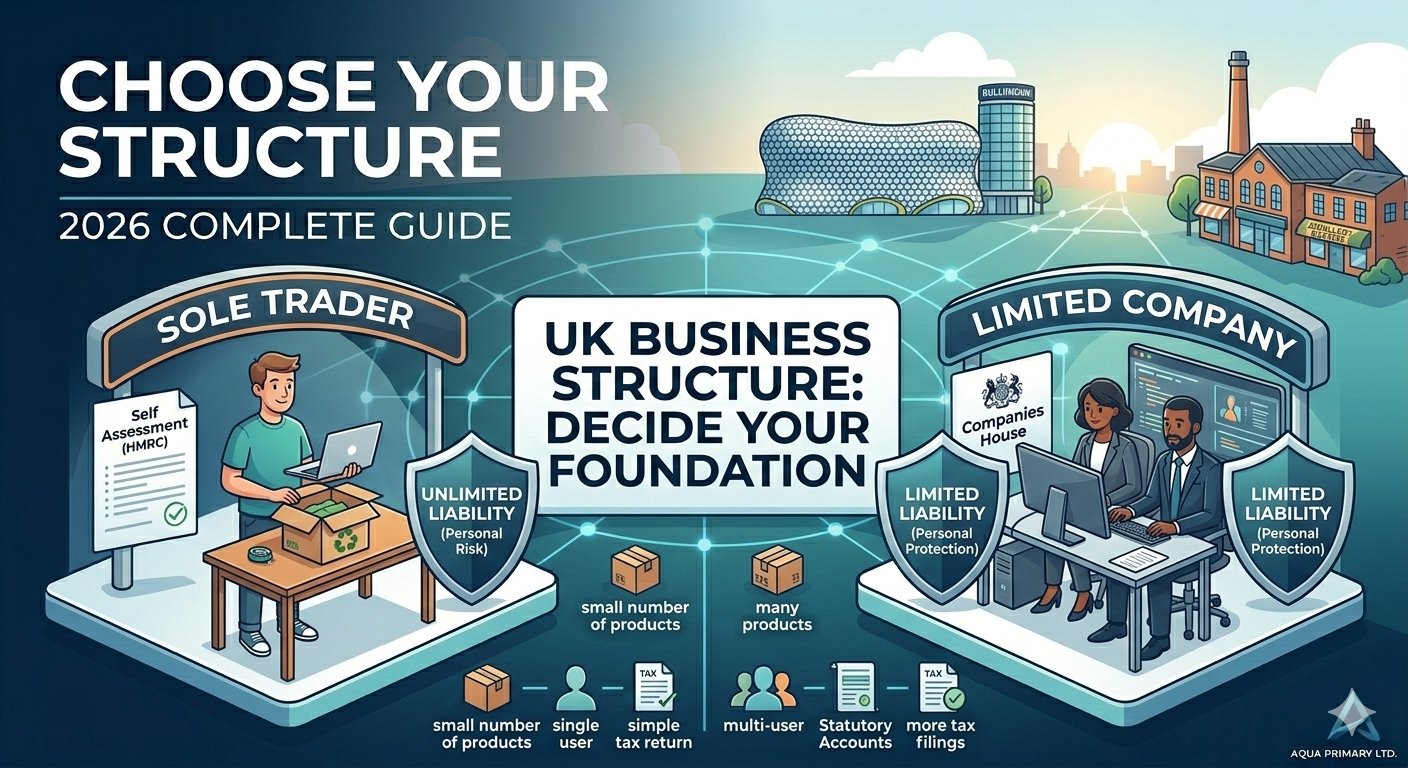
When you are starting an online store, it’s easy to get lost in product sourcing, theme customization, and marketing strategies. However, one of the most critical decisions you will make—one that impacts your legal responsibility, your tax bill, and your business’s future—is deciding your business structure.
In the UK, this choice almost always comes down to two options: Operating as a Sole Trader or incorporating as a Limited Company.
This decision is not static. As your sales grow and your business model evolves, the “correct” choice might change. For UK-based e-commerce sellers in 2026, where digital trade is highly regulated and incredibly fast-paced, choosing the right foundation is paramount. In this Aqua Primary Ltd guide, we provide a strictly informative, human-written analysis of both structures to help you decide which path is right for your digital enterprise.
1. What is a Sole Trader?
Being a Sole Trader is the simplest way to run a business in the UK.
The Concept
As a Sole Trader, you are the business. Legally and financially, there is no distinction between you and your e-commerce store. You own all the assets (the stock, the laptop, the domain name), and you keep all the profits after you have paid tax on them.
Registration: Setting up is incredibly easy. You simply register for Self Assessment with HMRC. You have until October 5th after the end of the tax year you started trading to notify them.+1
Key Characteristics in the E-commerce Context:
- Total Control: You make all decisions without consulting shareholders or directors.
- Minimal Admin: Your main responsibility is keeping accurate records of your sales and expenses, and filing an annual Self Assessment tax return.
- Speed to Market: You can start selling almost instantly.
The Big Risk: Unlimited Liability
The defining feature of a Sole Trader is unlimited liability. Because you and the business are the same entity, you are personally responsible for all the business’s debts. If your e-commerce store fails, gets sued, or can’t pay its suppliers, your personal assets—including your savings, your car, and even your home—are at risk.
2. What is a Limited Company?
A Limited Company is a separate legal and financial entity.
The Concept
When you form a Limited Company, you are creating a new “legal person.” The company owns the business assets, incurs the debts, and is responsible for its actions. You are (usually) a shareholder (owning the company) and a Director (running the company).
Registration: To create a Limited Company, you must “incorporate” it via Companies House. In 2026, this is a streamlined, all-digital process, typically costing around £100 and finalized within 24 hours.
Key Characteristics in the E-commerce Context:
- A “Professional” Brand: Operating as a Limited Company (e.g., “Aqua Primary Ltd”) often builds more trust with customers, large suppliers, and potential investors.
- Access to Capital: It is generally easier for a Limited Company to secure business loans and attract investment (by selling shares).
The Big Advantage: Limited Liability
The primary reason to form a company is limited liability. Your personal liability for the company’s debts is capped (usually at the value of your initial investment in the shares). If the business fails, your personal assets are generally protected from the company’s creditors.
3. Comparison of Admin and Tax (2026 UK Perspective)
Here is where the two structures diverge significantly regarding workload and cost.
E-commerce Accounting Workload
| Feature | Sole Trader | Limited Company |
| Record Keeping | Simpler. Keep track of income vs. expenditure. | Complex. Must follow strict accounting standards. A dedicated business bank account is mandatory. |
| Annual Filings | One annual Self Assessment (Tax Return) (personal + business income combined). | Four major filings: 1. Full Statutory Accounts. 2. Company Tax Return (CT600). 3. Confirmation Statement (annual snapshot). 4. (If applicable) VAT Returns. |
| Public Transparency | High privacy. Only HMRC sees your records. | Low privacy. Your Statutory Accounts, company address, and Director details are public record on the Companies House register. |
| The Verdict on Admin | Low workload. You can manage it yourself initially. | High workload. Almost certainly requires a qualified accountant (estimate £1,000–£2,500+ annually in 2026 fees). |
UK Tax Structures in 2026
The way you are taxed differs fundamentally. Note: Tax rules can change; always seek professional advice.
Sole Trader Tax
You pay Income Tax on your business profits (the total sales minus allowable expenses) in the same way an employee does, using personal tax-free allowances (£12,570 in 2026) and bands (20%, 40%, 45%). You also pay National Insurance Contributions (NICs) (Class 2 and Class 4).+1
Limited Company Tax
The company pays Corporation Tax (likely 25% or more in 2026) on its profits first.
You then draw money out of the company in two ways:
- Salary: You are paid as an employee. The company must operate a PAYE (Pay As You Earn) payroll system, and both you and the company pay NICs.
- Dividends: After the company pays Corporation Tax, it can distribute the remaining profit to you as the shareholder. Dividends do not incur NICs, and you are taxed personally at a lower rate than standard Income Tax (there is a separate £1,000 dividend tax-free allowance in 2026). This is often the more tax-efficient route.
4. How E-commerce Challenges Impact the Decision
The unique nature of online selling makes certain aspects of this choice more pressing:
A. Risk Factors
E-commerce is highly exposed. Your site could inadvertently breach UK copyright laws (e.g., selling “inspired by” designs). A customer could suffer a reaction to a cosmetic product or get injured by a faulty gadget you sold. If you are a Sole Trader and get sued, it is your house on the line. Limited liability provides essential protection.+1
B. High Growth & Investment
Successful e-commerce stores can scale rapidly. If your plan is to sell your brand in 3-5 years or bring in significant investment to buy huge bulk stock, you should operate as a Limited Company from the beginning. Investors and buyers will not touch a Sole Trader business.
C. VAT Threshold
The decision to register for VAT (currently £90,000 turnover) is separate from your structure. However, it’s worth noting that voluntary VAT registration (registering before you reach the threshold) is often easier to manage within a Limited Company structure and can add a layer of perceived size and credibility.
5. The Conclusion: What’s Best for You?
The “right” answer depends entirely on your business model, scale, and appetite for risk.
Aqua Primary Ltd’s Final Advice:
Start as a Sole Trader if:
- You are a solo founder launching a “hobby-business” or testing the waters with low initial stock investment.
- Your e-commerce model is low-risk (e.g., selling greeting cards, artisanal crafts, or print-on-demand where you never hold stock).
- Your primary goal is to minimize administrative costs and keep accounting simple. You can always “incorporate” later if the business proves successful.
Register a Limited Company if:
- You are holding significant, high-value inventory.
- You are selling higher-risk products (e.g., tech gadgets, food, beauty products) where limited liability is essential protection.
- You are a partnership of two or more people.
- You have immediate plans to scale nationally, hire staff, seek large investment, or build a professional, sellable brand.
- Your estimated profits (not turnover) exceed £35,000–£40,000 annually. (Historically, this has been the tipping point where Limited Company tax efficiency offsets the higher administrative/accounting costs).