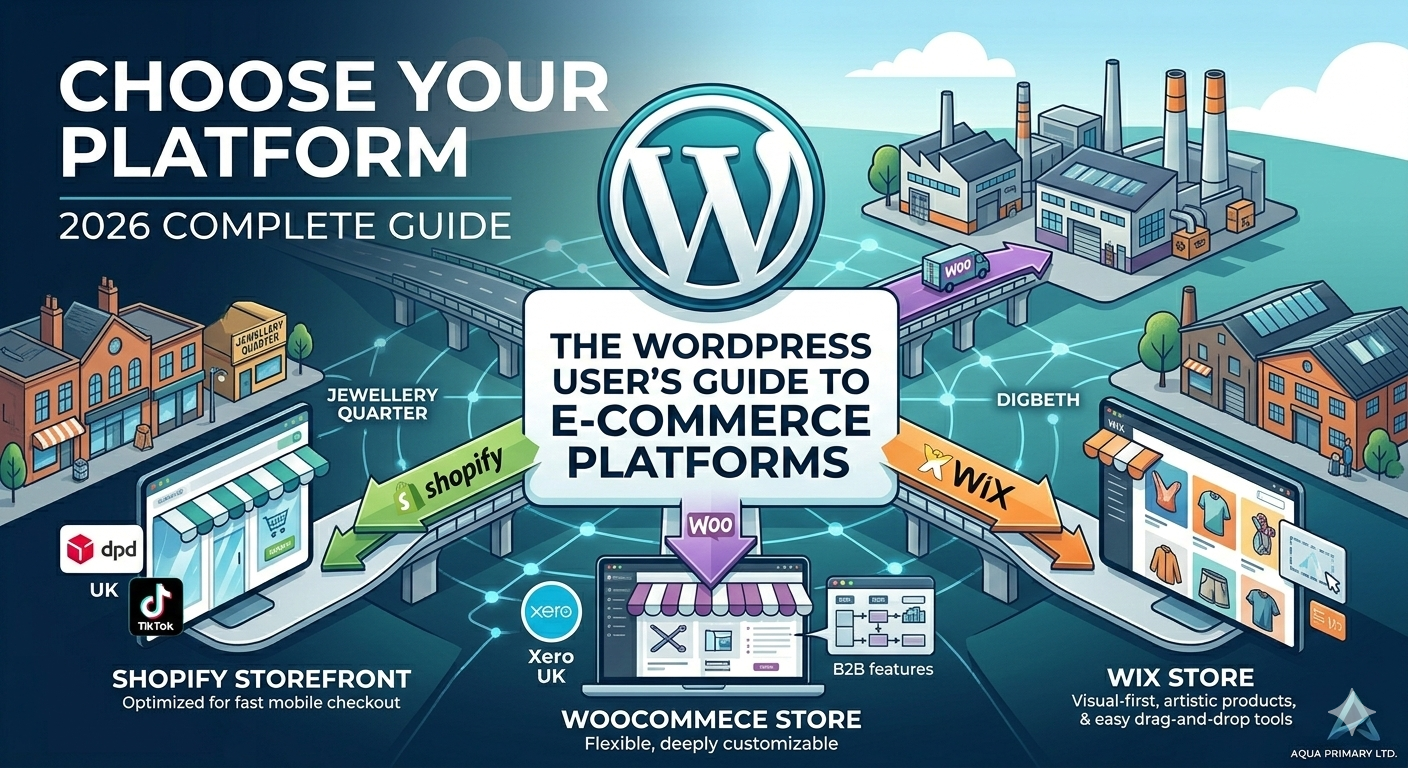
One of the first, most critical decisions an e-commerce entrepreneur in Birmingham must make is deciding where their digital store will “live.” In 2026, the digital landscape has stabilized, yet the choice between the major platforms remains a nuanced one. Your platform is not just a website; it is the engine that drives your sales, manages your inventory, handles your customers’ data, and connects with your local and global logistics.
For Birmingham-based businesses, this decision is amplified. Are you targeting the independent, creative pulse of Digbeth? The heritage-rich customers of the Jewellery Quarter? Or are you a high-volume manufacturer utilizing the city’s robust transport links to ship nationally?
In this comprehensive human-written guide, Aqua Primary Ltd breaks down the three leading contenders—Shopify, WooCommerce, and Wix—through a strictly informative, platform-agnostic lens. We will analyze their strengths, weaknesses, costs, and, crucially, how they perform within the specific context of the Birmingham and UK business ecosystems in 2026.
The Landscape in 2026: An Overview
Before we dive into the specific platforms, it’s vital to understand the technological environment. By 2026, several key shifts have occurred:
- Social Commerce Integration: The separation between an e-commerce website and platforms like TikTok, Instagram, and even local community apps has vanished. A platform must have seamless, native synchronization with social shops.
- AI-Driven Management: Platforms are no longer just passive tools. They actively use AI for inventory forecasting, personalized customer journeys, and automated marketing.
- Speed and Stability: For UK consumers, a slow-loading site is a dead site. A 2026 study showed that 70% of UK shoppers will abandon a mobile cart if the checkout takes more than 10 seconds.
- Compliance and Security: UK GDPR and consumer protection laws are stricter than ever. Your platform must handle security patches and data privacy with minimal effort from you.
With this context, let’s evaluate our three contenders.
1. Shopify: The E-commerce Powerhouse
Shopify remains the market leader in 2026 for a reason. It is a “SaaS” (Software as a Service) platform, meaning everything—hosting, security, checkout, and core feature updates—is managed by Shopify.
The Shopify Experience
- All-in-One Simplicity: Shopify’s biggest selling point is that you can get a store online in hours. The interface is intuitive, and their core features (product management, orders, discounts) are world-class.
- Unmatched Ecosystem: Shopify’s App Store is the most extensive in the market. In 2026, this means advanced native integration with every UK courier, accounting software (like Xero UK), and marketing tool you can imagine.
- Checkout Speed: Shopify’s checkout (including Shop Pay) is notoriously the fastest and highest-converting in the industry.
The Birmingham Context for Shopify
Shopify is ideal for Birmingham businesses that prioritize speed-to-market and operational simplicity over total technical control. If you are a fashion startup in the Jewellery Quarter and want to focus on design and marketing, not server management, Shopify is a strong fit.
It is also the best platform if you plan to utilize Shopify POS (Point of Sale) for pop-up shops in Birmingham (e.g., at the Custard Factory markets or near the Bullring). The inventory sync between online and in-person sales is flawless.
Costs and Drawbacks
- Monthly Fees: Shopify has clear monthly costs (ranging from around £20 to £300+ for standard plans).
- Transaction Fees: If you do not use Shopify Payments, they charge an additional transaction fee.
- Customization Limits: While highly flexible, you do not have “root access” to the code. If you want a hyper-customized database function that Shopify doesn’t support, you may hit a wall.
2. WooCommerce: The Flexible, Self-Hosted Champion
WooCommerce is not a standalone platform; it is a powerful plugin that turns a WordPress website into a fully functional e-commerce store. This means it is “open-source” and “self-hosted.”
The WooCommerce Experience
- Ultimate Control: You own everything. You choose the hosting provider, manage the security, and can modify 100% of the code. If you can dream of a custom feature, a developer can build it on WooCommerce.
- The Power of WordPress: Since it’s built on WordPress, it offers the most robust blogging and content management system of any e-commerce platform.
- Scalability on Your Terms: While you must manage the technical scaling, WooCommerce can handle enterprise-level volume provided you have the right hosting infrastructure.
The Birmingham Context for WooCommerce
WooCommerce is a favorite among B2B (Business-to-Business) companies, manufacturers, and technical founders in Birmingham. If you are, for example, a manufacturer in Tyseley needing a highly complex wholesale portal with bespoke pricing tiered for different local clients, WooCommerce offers the flexibility to build it.
It’s also an excellent option if your business heavily relies on organic traffic (SEO). WooCommerce’s content tools make it the superior choice for high-level content marketing in the competitive UK landscape.
Costs and Drawbacks
- Deceptive Low Costs: The core plugin is free, but you must pay for high-quality UK hosting, security (SSL certificates, firewalls), premium themes, and extensions (which add up quickly).
- Technical Responsibility: You are the IT manager. If a plugin update breaks your site or you are hacked, it’s up to you (or your developer) to fix it.
- Complexity: It has a much steeper learning curve than Shopify or Wix.
3. Wix: The “Quick-Start” Visual Builder
Wix, like Shopify, is a SaaS (all-in-one) platform. It built its reputation as a visual, drag-and-drop website builder and has aggressively advanced its e-commerce capabilities in recent years.
The Wix Experience
- Unrivaled Ease of Use: Wix’s “drag-and-drop” editor is the most user-friendly on the market. If you can use PowerPoint, you can build a decent-looking Wix store.
- Visual-First Design: It is designed for stunning, visual-heavy websites, making it the top choice for design-conscious sellers.
- Rapid Deployment: Perfect for getting a beautiful “brochure-style” e-commerce site up with minimal fuss.
The Birmingham Context for Wix
Wix is the best choice for Birmingham’s creative independents: artists in Digbeth, artisanal food makers, photographers, or service-based businesses that also want to sell a small selection of products online.
If your primary goal is to sell your brand and your portfolio first, and the product second, Wix’s visual approach works well. It is also excellent for small, localized operations in Solihull or Sutton Coldfield that only plan to manage 20–50 products.
Costs and Drawbacks
- Hidden Limitations: While beautiful, Wix can be slow when managing hundreds of products. Its inventory and order management systems are significantly less powerful than Shopify or WooCommerce.
- Template Lock-in: Once you choose a template, you are locked into its core structure. Changing templates means rebuilding your site.
- Scalability: While suitable for small and medium businesses, we would not recommend Wix for a brand planning to scale to thousands of products or national volume quickly.
The 2026 Comparison: At a Glance
| Feature | Shopify | WooCommerce | Wix |
| Model | SaaS (Hosted) | Open Source (Self-Hosted) | SaaS (Hosted) |
| Setup Time | Very Fast (Hours) | Slow (Days/Weeks) | Very Fast (Hours) |
| Ease of Use | High | Low/Medium | Very High |
| Design Flexibility | Medium/High | Unlimited | High (with template lock-in) |
| Content/SEO | Good | Excellent | Good |
| POS System | Native (Market Leader) | Requires Third-Party Integration | Native |
| Best For (Brum Context) | Scaling Retailers, Fashion, Multichannel Sellers (e.g., in the Jewellery Quarter). | B2B, Manufacturers, Technical Founders, Content-Heavy Brands (e.g., in Tyseley). | Small Creative Makers, Artists, Local Artisans, Portfolios (e.g., in Digbeth). |
Conclusion: Making Your Decision
The “right” platform doesn’t exist; only the right platform for your business model and your specific goals within the Birmingham market in 2026.
Here is Aqua Primary Ltd’s final advice:
- Choose Shopify if: You are serious about scaling quickly, want the least technical hassle, and plan to utilize social commerce and local pop-up retail to their full potential.
- Choose WooCommerce if: You are a developer or have access to one, you require total code control, or your business needs highly bespoke features, especially in the B2B or manufacturing space.
- Choose Wix if: You are a small, creative solo-founder who wants a stunning visual store that is incredibly easy to manage, and you have no immediate plans to manage huge inventory or volume.
Need more specific advice?
A platform decision is permanent. If you are still unsure which path to choose for your West Midlands enterprise, contact Aqua Primary Ltd. We provide localized e-commerce strategies that ensure your foundational technology is robust enough to meet the future of trade in 2026.